
There is a silent crisis unfolding before our eyes — and most cultural institutions have yet to grasp its full dimension.
According to the Pew Research Center, 38% of web pages that existed in 2013 are no longer accessible a decade later. We are not talking about abandoned personal blogs or forgotten websites. We are talking about historical records, artistic productions, cultural documents — collective memory that has simply evaporated.
The most emblematic case for us is Orkut — in 2007, 79% of social network users in Brazil were there — and its disappearance still reverberates as a disturbing silence. It also happens in the US: Myspace recently deleted an estimated 53 million music files from its servers, representing decades of independent musical production lost in a single corporate decision. These were not accidents. This was the logic of the system working exactly as designed:
“when information loses its perceived monetary value, commercial players have no incentive to keep it accessible.”
“Securing Digital Rights for Libraries: Towards an Affirmative Policy Agenda for a Better Internet (2022)”.
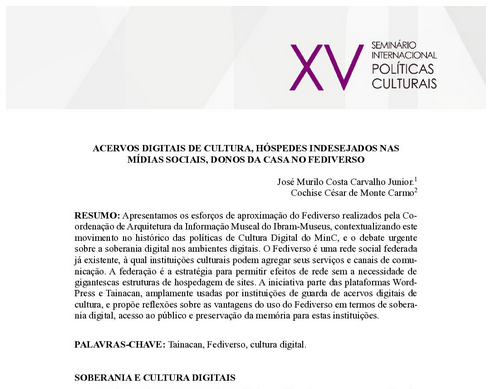
This post is inspired by the article “Cultural Heritage Digital Collections: Unwelcome Guests on Social Media, Homeowners on the Fediverse“, presented at the XV International Seminar on Cultural Policies.
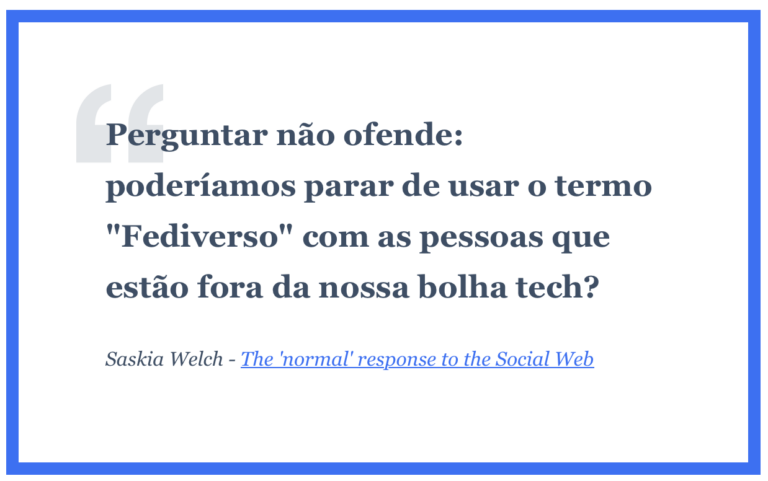
We have started experimenting with the term Social Web.
The Declaration for the Protection of Memory Institutions documents these risks with evidence — and the Internet Archive itself, the largest digital preservation initiative on the web, is today threatened by legal battles related to its preservation efforts. Commercial platforms have never been, and never will be, reliable guardians of cultural memory.
Guests in a house that is not ours
Faced with the need to reach online audiences, museums, archives, and libraries migrated en masse to the major platforms: Instagram, Facebook, Twitter/X, YouTube. The logic was understandable — go where the public is. But this decision came at a cost that is rarely discussed with the frankness it deserves.
On commercial social media, the rules of the house change without notice. Algorithms are altered overnight. Accounts are arbitrarily moderated or shut down. Terms of service are rewritten unilaterally. An institution that spent years building an audience of hundreds of thousands of followers can see its reach collapse — or its account simply disappear — with no real recourse.
We are guests. And, more often than not, unwelcome guests.
There is a further, deeply troubling irony in this scenario: if artificial intelligence companies can invoke fair use to scrape the internet and train their commercial models, then memory institutions surely deserve equivalent guarantees to preserve cultural heritage and fulfill their public interest mission. The imbalance is evident — and reveals that the rules of the game were written for other players.
Digital sovereignty is not a luxury — it is a mission
The concept of digital sovereignty may sound technical. But for cultural institutions it has a very concrete meaning: control over collection data, autonomy over the rules of access, and continuity guaranteed independently of corporate decisions.
When a museum publishes its collection exclusively on Instagram, who owns that content? When a library builds its community solely on Facebook, what happens to that network if the platform changes its policies — or simply ceases to exist?
The Aruba Declaration is direct: the right to collect and preserve openly accessible content on the internet is crucial for museums, archives, and libraries to continue fulfilling their public interest functions in relation to digital memory. This is not a technological preference. It is a fundamental principle.
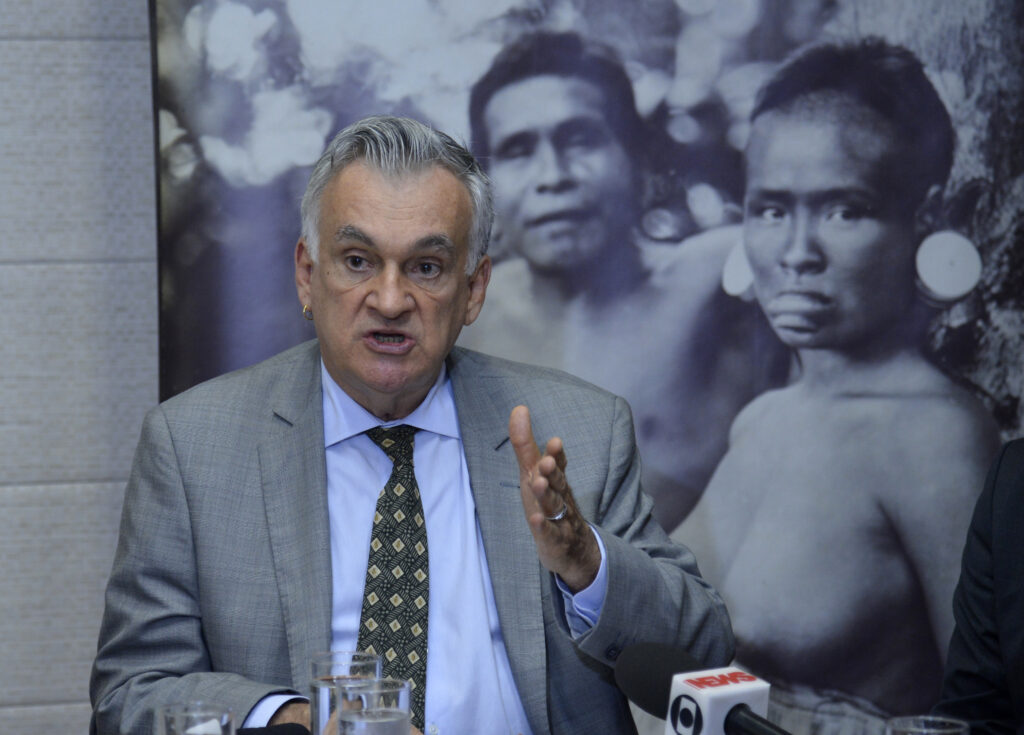
In 2015, reacting to Facebook‘s censorship of an image from Brasiliana Fotográfica, Brazil’s Minister of Culture Juca Ferreira stated that the platform was affronting Brazilian sovereignty and legislation. The episode is the Ground Zero of Digital Sovereignty in cultural collections in Brazil.
Digital sovereignty for cultural institutions operates across three mutually reinforcing dimensions:
- Preservation — who guarantees that content will exist tomorrow?
- Access — who controls who can see what, and under what conditions?
- Institutional identity — who defines the narrative about cultural heritage?
Without sovereignty across these three dimensions, there is no real preservation of cultural memory. There is only an illusion of digital presence.
On the Social Web, we own the house
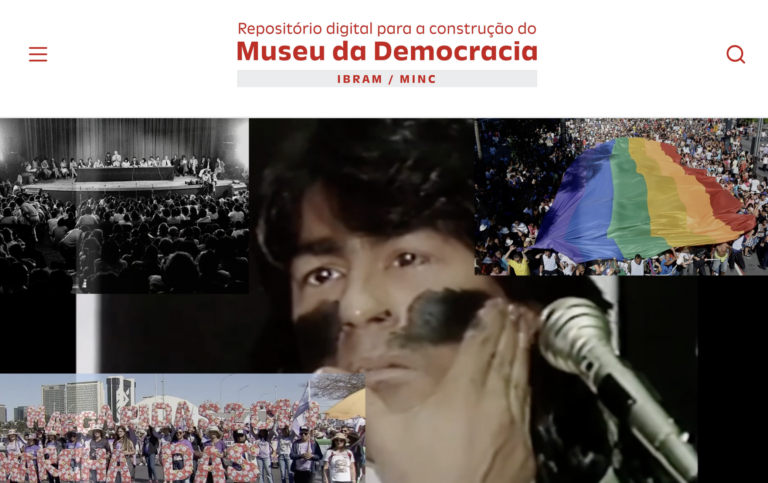
The current landscape of social networks, combined with a propitious moment, led us to imagine that a public policy initiative in this field could produce a meaningful demonstration effect. This is why Ibram believes it is timely to carry out an experiment with federated social networks and museums — memory institutions.
The Social Web — a constellation of decentralized networks such as Mastodon, Pixelfed, and PeerTube, built on the open ActivityPub protocol — offers precisely what commercial platforms will never offer: the possibility for each institution to operate its own server, with its own rules, its own data, and its own identity. And still communicate with the entire network.
Even though each Social Web instance has its own management, identity, and rules, all of them can interact with one another, forming a diverse, interconnected, and cooperative ecosystem.
On commercial social media, the platform is the owner. On the Social Web, the institution owns the house.
For museums, archives, and libraries [and also universities], this translates into something concrete: full control over collection metadata and content; interoperability with other institutions and with the public; independence from opaque algorithms and corporate decisions; and alignment with the principles of open access and the public good.
With the existence of a public protocol and the possibility of institutions managing their own databases, we can begin to handle digital memory in an institutional manner. This opens up a considerable field of action for information science professionals, museologists, archivists, and librarians, and enhances innovation in the digital interfaces of memory institutions.
Museums as protagonists of the future
There is a vision worth taking seriously: cultural institutions should not arrive at the Social Web as latecomers, following a technological trend. They should arrive as protagonists — and they have every condition to do so.
This is what the priorities outlined in My Dream for the Fediverse, by Elena Rossini (“I have a dream”), point to: museums, archives, and libraries have a central role in the popularization of the Fediverse — not as trend-followers, but as anchors of trust and reference for the public.
Why? Because they possess credibility and public legitimacy consolidated over decades. Because they have an explicit mission of preservation and access to heritage — and the Social Web is a natural means to fulfill it. Because they can attract communities around quality cultural content. And because they can create federated networks among themselves — museums, archives, and libraries connected by open protocols, sharing collections and audiences.
This initiative represents one of the first strategies in Brazilian public policy to address the monopolistic control of commercial social networks by BigTech companies. Ibram believes that Brazilian museums have a contribution to make to the broader reflection on the future of the digital environment, and this initiative with decentralized social networks signals a path we propose to explore.
When a reference museum arrives on the Social Web, it does not merely solve its own digital sovereignty problem. It legitimizes the space, attracts its audience, and demonstrates that it is possible to have a quality digital presence outside the major platforms. The first experiment we conducted — publishing from Brasiliana blog posts directly into the decentralized social network environment — produced a surprising increase in site visits. The demonstration effect is powerful. And it is exactly the kind of leadership the Fediverse needs to grow beyond technological circles.
From reflection to action
Democracy, and all of humanity, lose when interests driven exclusively by profit override public interest considerations regarding access to information, knowledge, and culture. This is not a rhetorical statement. It is a description of what is happening right now, in real time, with cultural digital memory.
The internet is not just a tool but a space for social existence, movements articulation, and the creation of shared meaning. As such, the design and governance of digital technologies are inherently political issues. The time has come to reimagine the internet as a space for collective empowerment and cultural expression. Ibram believes that museums can lead the way in this transformation.
There are concrete steps any cultural institution can take today. Audit current platform dependency — map where institutional content lives, and what would happen if each platform disappeared tomorrow. Experiment with the Social Web — create an instance, publish collections, connect with other institutions. And articulate — support initiatives like the Aruba Declaration, participate in networks like Alquimídia, WebSocialBR and Organica.social, and connect with those already on this path.
This is a beginning — a modest experiment, but one that may carry great significance. We hope it marks the start of a transformative movement in the way we, as individuals and as institutions, connect online, and that it leads to a deeper and more meaningful relationship with the digital and with the web.
The Social Web needs cultural institutions. And cultural institutions need the Social Web.
Cultural heritage digital collections deserve a home of their own. And the Social Web is that home.