

Below, we present the slides and the text of José Murilo’s presentation, representing Ibram-Museus at the 1st WebSocialBR in Brasília, on December 3, 2025.
Slide 1 – Museums in the Fediverse: Experiments by Ibram-Museus with Tainacan, ActivityPub, and WebSocial
It is a pleasure to participate in this event, and I want to thank everyone involved in making it happen. This will be an opportunity to present the reflections and experiments that Ibram-Museus is conducting on the topic of decentralized social networks. We also want to listen to all the initiatives presented here and make ourselves available for effective dialogue around ideas, strategies, and applications to develop this environment of decentralized social networks within public policy.
Slide 2 – Why the Fediverse?
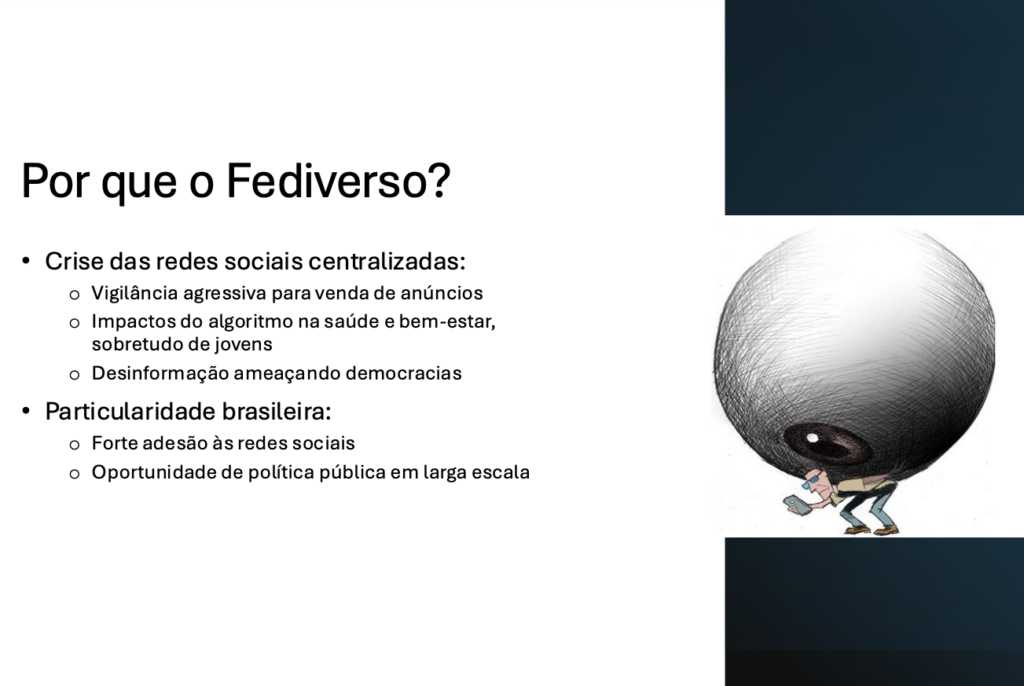
Following Elon Musk’s acquisition of Twitter in 2023, experts and politicians in Brazil and abroad have recognized that the free services provided by Big Tech social networks—tainted with aggressive surveillance schemes for customized advertising—are harming the health and well-being of users, especially young people. The problem of misinformation, on the other hand, poses threats to democratic regimes.
This undesirable scenario in the social media environment, combined with Brazilians’ special preference for this mode of online communication, led us to imagine that a public policy for this field, in a country as large as Brazil, could have a significant demonstrative effect. Therefore, Ibram believes it is timely to conduct an experiment with federated social networks and museums—memory institutions.
Slide 3 – Why Museums in the Fediverse? Tainacan…
![Por que Museus no Fediverso? Tainacan...
Em 2023: construção de capacidade para operar políticas públicas de Cultura Digital de maneira autônoma no Ibram
Desenho institucional:
- Sistemas de informação museal iluminados pela Ciência da Informação
- Envolvimento ativo de museólogos, arquivistas e bibliotecários
Resultados em 10 anos:
- Versões em 12 línguas
- +2.000 instâncias ativas
- +40.000 downloads[(]](https://josemurilo.com/wp-content/uploads/2025/12/Screenshot-2025-12-05-at-06.50.49-e1764973318462-1024x658.png)
Since 2016, Ibram has been in an important partnership with public universities to develop the Tainacan Project. It is a digital repository application in open-source software, specialized in the online publication of digital collections, which Ibram presents as an integral part of the Networked Collection Program—a public policy based on open-source software.
In the management that began in 2023, especially with the administrative restructuring of Ibram, we managed to expand the scale of digital services offered by Ibram to the museum field. To achieve this, it was necessary to accelerate the institute’s capacity to operate Digital Culture public policies autonomously, and for this, cooperation with Information Science departments at public universities was crucial.
The institutional design proposed for this Ibram-University cooperation favored the involvement of young museologists, archivists, and librarians in the formulation and implementation of applications and in activating networks for the museum field.
In these 10 years of development, a measure of Tainacan’s performance and its community in the field of digital memory is the fact that the software already has versions in 12 languages, with more than 2,000 active instances and over 40,000 downloads.
Slide 4 – The First Step: Brasiliana Museus
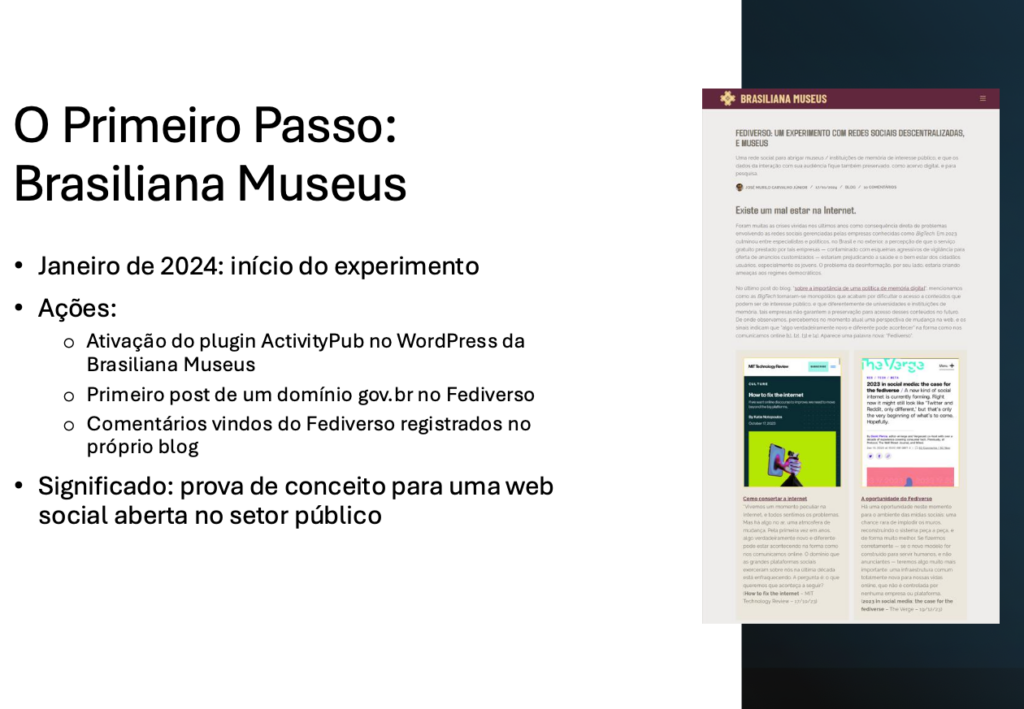
To inaugurate the initiative of Brazilian Museums in the Fediverse, in January 2024, we activated the ActivityPub plugin on the Brasiliana Museus WordPress site and published the first post from a gov.br domain on the web social, i.e., in the Fediverse. Comments on this post, originating in the Fediverse, were also recorded in the comments section of the post on the Brasiliana blog, demonstrating the possibility of integrating institutional websites with the Fediverse.
It is important to mention that Brasiliana Museus is a service for aggregating museological collections developed from Tainacan, which became the basis for developing new applications, as we will see later.
It was a beginning, a simple experiment, but we consider that the initiative had great significance. Our hope was that it would be the start of a transformative process in how we, as people and institutions, connect online, and that it could provide an improvement in our fundamental relationship with the digital and the web.
Slide 5 – Tainacan + WordPress + ActivityPub
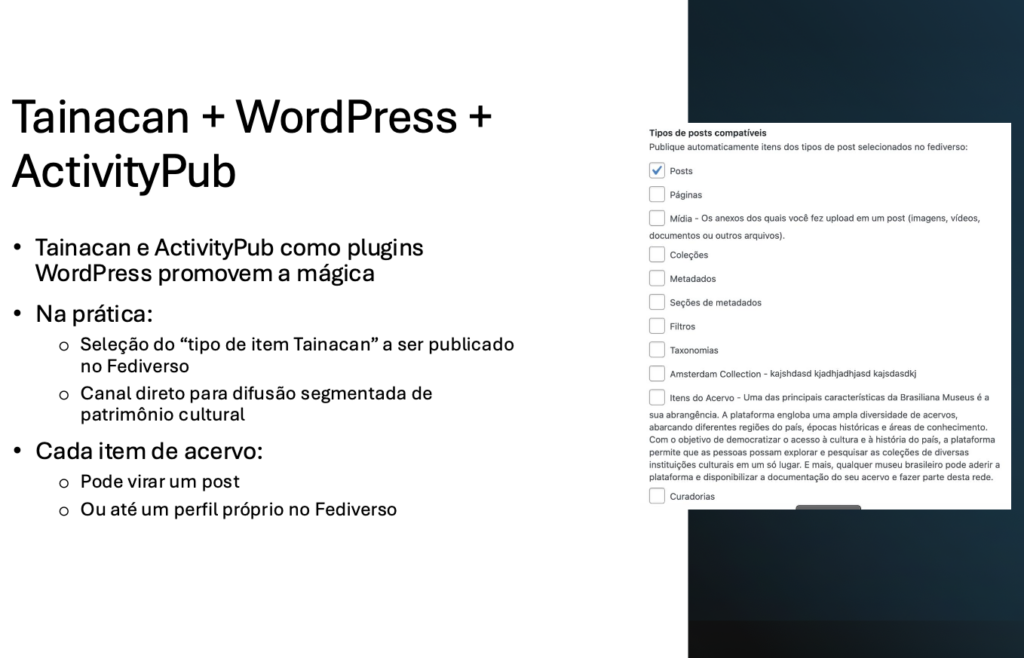
Technical aspects: The Tainacan Project is developed as a plugin for WordPress, just like the ActivityPub plugin, which connects WordPress to the Fediverse. WordPress, in turn, is used on 43.4% of all websites on the internet, being the most popular content management platform in the world. The ecosystem expands as the community increases the library of available plugins.
Not by chance, recently, specialist Dave Winer, creator of the RSS format (an XML format for open web content distribution), declared that he sees WordPress as the ideal “OS” for the open social web.
As soon as we experimented with the WordPress ActivityPub plugin, we realized how we could immediately choose, in the plugin interface, the type of Tainacan post we could select for posting in the Fediverse.
In other words, Tainacan, as if by magic, began to have a direct channel for segmented dissemination of cultural heritage content to subscribing users. At that moment, the Tainacan team at Ibram was impacted by what we could imagine in terms of new applications of Tainacan for decentralized social networks.
From there, we defined the initiative’s objective as providing museums and other memory institutions with a tool that facilitates exploring decentralized social networks as an environment for disseminating their collections.
From other experiments with museums in the Fediverse, such as the San Francisco Airport Museum (SFO Museum – ActivityPub Services), we realized that in the case of museum collections published in Tainacan, each item could become a post or even a new profile in the Fediverse—in the case, for example, of museum items of broad interest.
Slide 6 – Online Audience Management
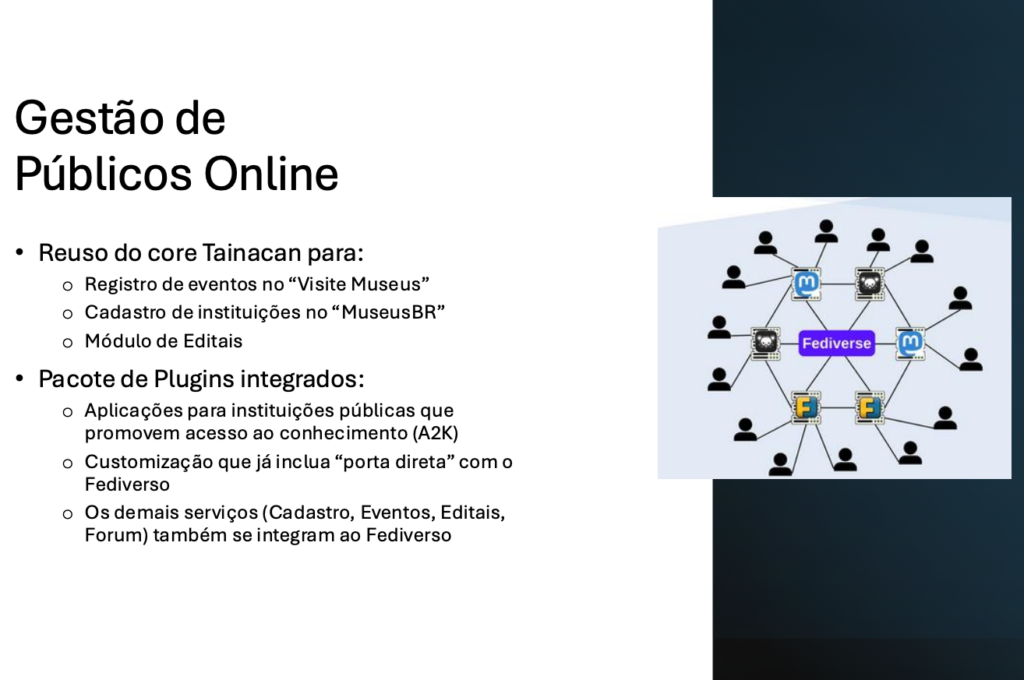
From the support and development teams’ work on Tainacan at Ibram, we have been adapting the core application for developing other functionalities beyond aggregation, such as event registration on the “Visit Museums” site, and for registering memory institutions in the “MuseusBR” service. Another planned initiative is developing the module of public notices that would complete, along with Tainacan, what we consider a package of useful applications for public institutions. The most interesting aspect is that these new applications, developed within the WordPress ecosystem, like Tainacan, immediately integrate into the Fediverse.
For this reason, we understand that the moment is opportune in the Tainacan community to embrace the connection with the Fediverse and effectively explore how memory institutions can make the most of the open social web. The goal is to provide institutions that promote access to knowledge with updated tools for managing their online audiences.
Slide 7 – On the Role of Universities
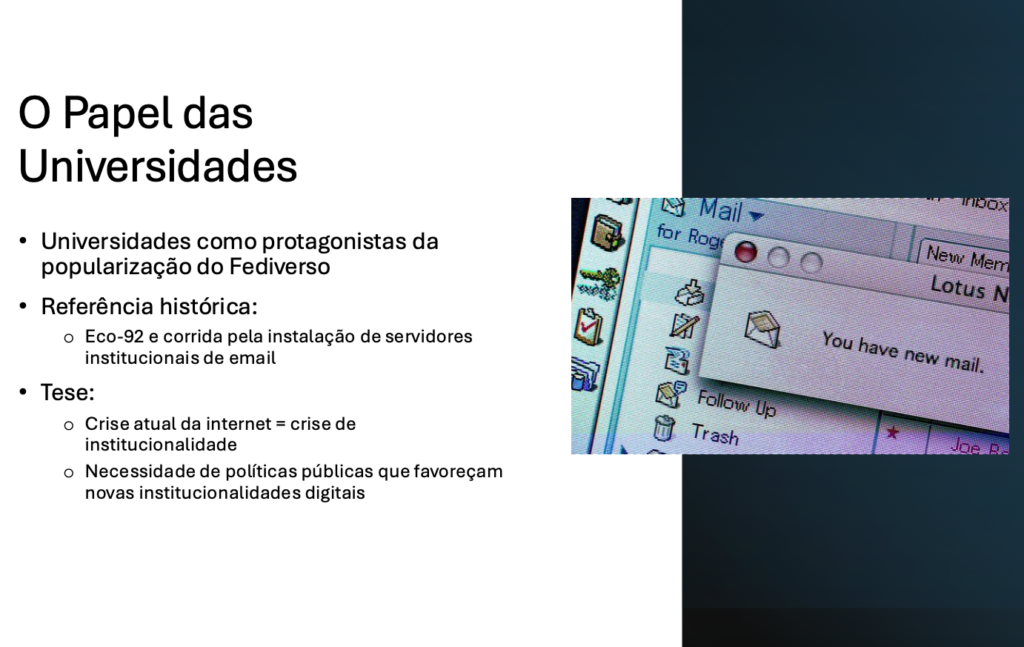
When I think about the challenge of launching a strategy to popularize the Fediverse in Brazil, I cannot help but think of universities as institutions best positioned for leadership. It is impossible not to remember the mobilization period for Eco-92, where universities entered into a healthy competition in terms of diligence in installing their first institutional email servers. At that time, the internet was born under the auspices of institutionalization.
The problems of the Internet certainly have multiple causes and ingredients, but from the perspective of the Brazilian Institute of Museums, they present the contours of an institutional crisis. This is because technologies that mediate social relations, like the Internet, intrinsically create institutions.
A coordination mechanism that enables collective action, with the capacity to process information to solve increasingly complex problems, regardless of whether it is supported by information technology, is an institution.
Slide 8 – Public Policy vs. Monopoly Logic
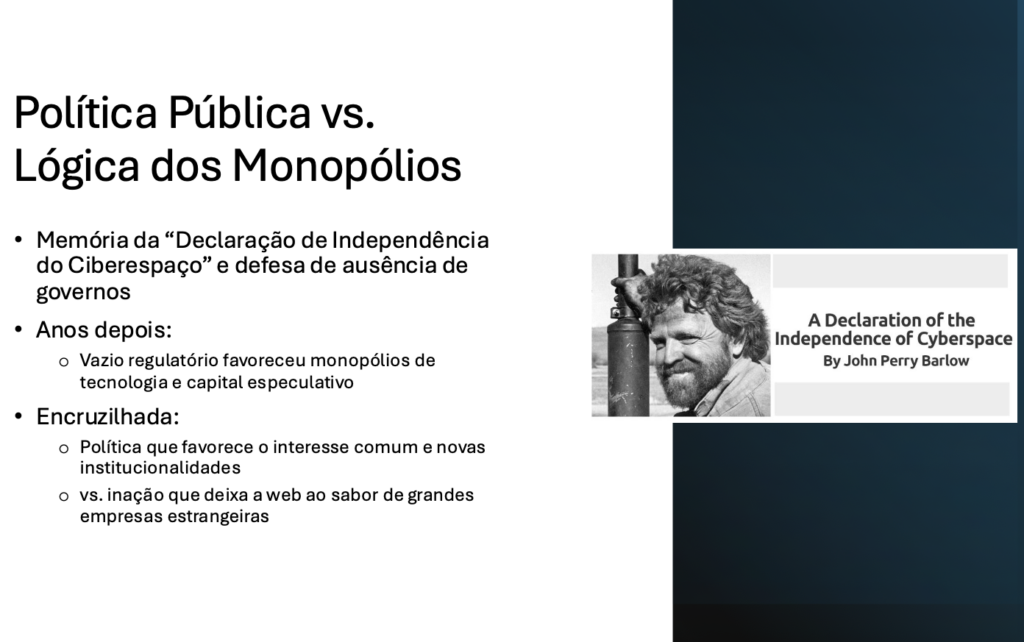
In the early days of the Internet, there was a group of ‘hackers’ who advocated for the total absence of government action in the digital environment. This happened with the publication of the Declaration of the Independence of Cyberspace. The last 20 years seem to indicate that the absence of public policy only favored the takeover of the web by speculative capital interests and transnational monopolies.
“Governments of the Industrial World, you weary giants of flesh and steel, I come from Cyberspace, the new home of the Mind. In the name of the future, I ask you from the past to leave us alone. You are not welcome among us. You have no sovereignty where we gather.” (Davos, Feb / 1996)
The crucial decision is between the policy that defends the common interest and deliberately favors the emergence of new digital institutionalities on the network, and the blind policy that, through inaction, allows the evolution of the digital environment to occur randomly, at the whim of the interests of large foreign technology companies.
We could perhaps imagine a “Declaration for a Public Interest Cyberspace” to counter John Barlow’s declaration in the 90s.
Slide 9 – The App as an Adoption Strategy
Here I want to mention one last development of Ibram’s experiments with the Fediverse, which emerged as a very interesting opportunity.
The great challenge is how to guide the transition from the centralized, proprietary environment to the decentralized environment, which establishes distributed responsibilities and an expanded role for institutions that promote access to knowledge.
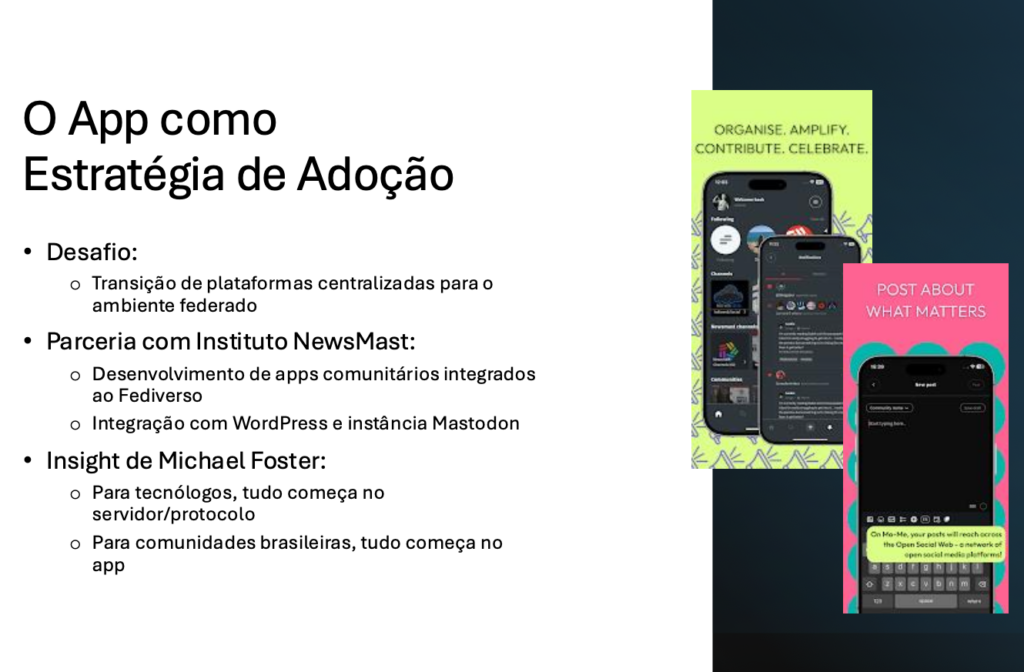
In the last 2 years, we have conducted some experiments, and recently we have been in contact with Michael Foster from the NewsMast Foundation. It is an organization dedicated to developing the WebSocial, offering the possibility of creating community apps for organizations interested in exploring the Fediverse.
The app works integrated with WordPress and promotes community engagement based on a Mastodon instance. In other words, through the partnership with the NewsMast Foundation, Ibram plans to boost the strategy of occupying the Fediverse by Brazilian museums.
Michael Foster, who is part of the project, often says that the Fediverse is an environment determined by technology, where everything starts with a server or even a protocol. However, this is not the case for people in general or communities in general. For communities and people, especially in Brazil, social spaces start with an app.
The Ibram app is born from the set of users of the Forum (WordPress) that developed the National Sectorial Museums Plan – PNSM in a participatory manner and is coupled to the Fediverse instance (social.museus.gov.br) where we intend to offer Brazilian museums the opportunity to create institutional accounts. If everything goes as planned, at the beginning of 2026, we will launch the “Museums in the Fediverse” app in the Android and Apple stores.
Slide 10 – Summary
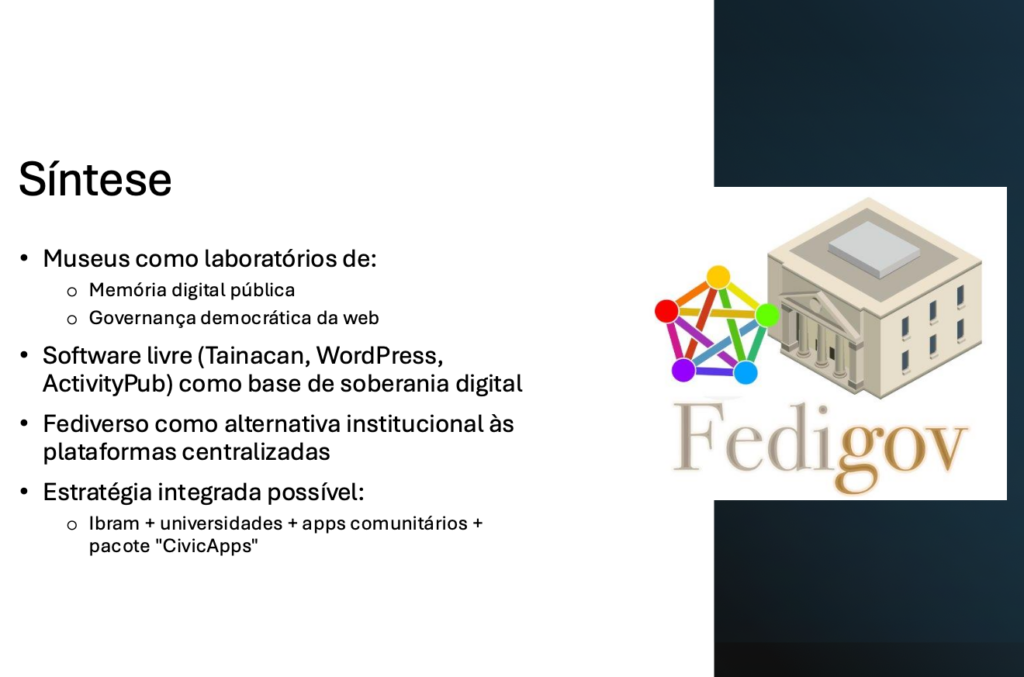
The network technology that mediates much of our lives is social engineering—which means that deciding how it works is (or should be) a political issue. If we want to have any hope that these collective digital spaces will result in a world worth living in, we need to build our Internet policies based on solid institutional principles.
It matters to museums, for example, that if there is a social network service willing to host memory institutions of public interest, the data of the museums’ interaction with their interested public is also preserved as a digital collection and for research.
Ibram understands that Brazilian museums have a contribution to make in reflecting on the future of the digital environment, especially concerning the issue of digital memory.
The Entry Guide to the Fediverse
lançado pelo Ibram por ocasião de evento, em 03/12
As a result of this internal reflection by Ibram-Museus, and in support of the 1st WebSocialBR, the Brazilian Fediverse Forum was an opportunity for the launch of the ‘Entry Guide to the Fediverse.’ It is a digital booklet with basic information for anyone interested in exploring the universe of decentralized social networks. We invite you to discover this alternative to the capture promoted by centralized platforms and their algorithms — download the Guide and take your first steps into the Fediverse.